The materials used in Torre Alfina Castle

Stone, Time and the Local Area: Materials that Tell a Story

The story of Torre Alfina Castle can be told through dates, noble families, historical events and famous figures. But there is also another way to explore its history: by observing the materials from which it is built. The materials of Torre Alfina Castle – from stone to wood, from frescoes to decorated surfaces – preserve precious traces of its transformations and its relationship with the local area.

Visiting the castle therefore means walking through not only historic settings, but also materials that preserve memories. Every surface tells a story: an architectural choice, a function, a style, a period in the castle’s history.

Table of Contents

Matter as the Castle’s Memory

At Torre Alfina Castle, what lingers in the memory is also a feeling: a distinctive stone, the way the light changes across the rooms, the contrast between the exterior and the interior, the constant interplay between architecture and landscape. The materials used in Torre Alfina Castle are far from neutral. In a historic building, every material has a function and a meaning. Stone protects, defines and commands attention. Wood welcomes, decorates and divides spaces. Frescoes transform walls into stories. Basalt brings strength, depth and character to interior spaces.

For this reason, the Castle can be interpreted as a collection of layers. Not everything dates from the same period; not everything was created with the same intention. Some features reflect its original defensive function, others its Renaissance transformation, and still others the major 19th-century renovation that helped to define the appearance of the castle as visitors see it today. Observing materials therefore means delving into a slower, less obvious but very precious story: that of surfaces which have stood the test of time.

The Neo-Gothic Façade of Torre Alfina

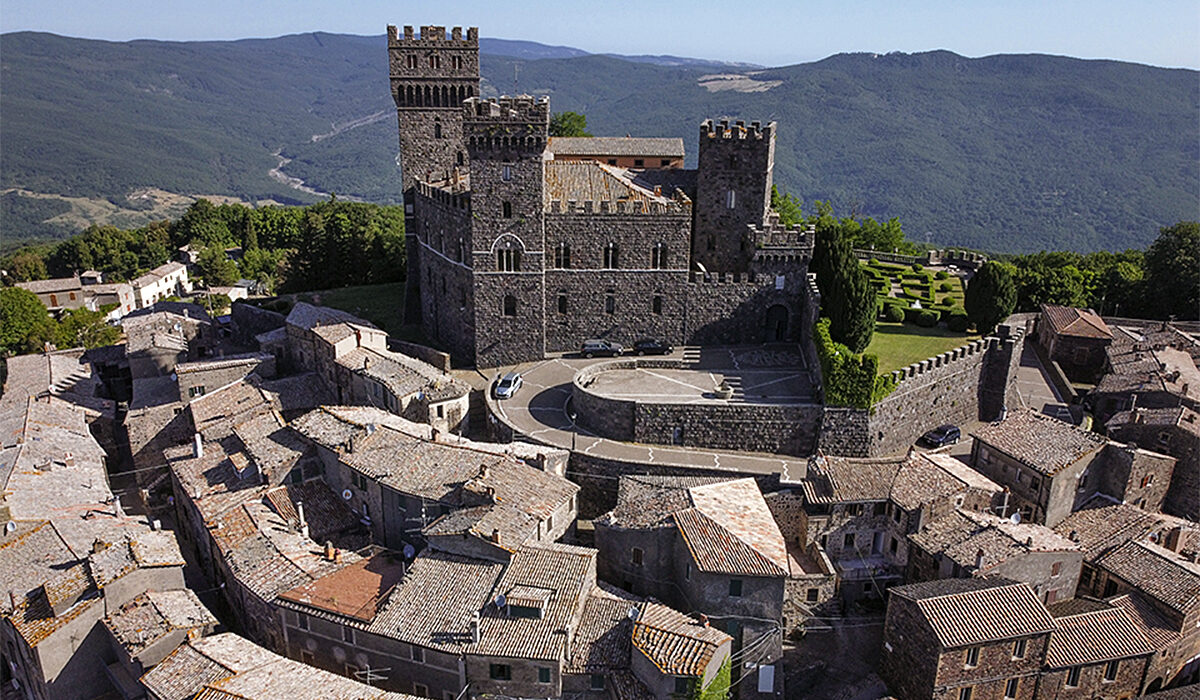
The image of Torre Alfina Castle is closely linked to its external appearance: towers, battlements, dramatic silhouette, stone, verticality. It is a powerful, almost fairy-tale-like image, which makes an impression even before you enter. This is the result of a long history of transformations. According to the available historical accounts, in 1880 Guido Bourbon del Monte sold the castle to Edoardo Cahen, who commissioned the Sienese architect Giuseppe Partini to carry out a major restoration project. The project It followed the neo-Gothic revival style of the time and helped to give the castle the character that still defines it today. Even the choice of materials reflects its connection with the local area. During the nineteenth-century restoration, according to available sources, a cladding in grey stone from Bagnoregio, used to redefine the external façade and give the building a more uniform, monumental and striking appearance.

The stone, in this sense, becomes an architectural language: it conveys a specific vision of a castle – imposing and romantic – capable of evoking the Middle Ages through the nineteenth-century sensibility of the Neo-Gothic revival. The result is a building that retains a dual character: on the one hand, its most ancient history of the fortification, on the other hand, the nineteenth-century reinterpretation which has emphasised its monumental and evocative character.

Traces of the Renaissance Beneath the Surface

Before the 19th-century alterations, The castle had already undergone significant alterations. Its history is linked to the Monaldeschi della Cervara family, which played a central role in the life of the local area and in the transformation of the ancient fortified structure. In particular, Sforza Monaldeschi della Cervara carried out work on the castle, transforming it from a defensive structure into a residence more in keeping with Renaissance tastes. At this stage, a number of prominent figures were brought in to further enhance the beauty of the materials used in Torre Alfina Castle: Ippolito Scalza for the sculpture and architecture, and Cesare Nebbia and his workshop for the painted decoration.

This stratification is one of the most interesting features of Torre Alfina Castle. The building does not reflect a single era, but rather several overlapping eras. Its 19th-century Neo-Gothic façade coexists with older elements, Renaissance traces, and rooms and details that reflect different functions, tastes and patrons. The castle, therefore, should not be viewed as a static image. Rather, it is a historical entity, transformed over time by families, architects, artists and craftsmen. Every intervention has left its mark; every material has added a layer to the overall narrative. And it is precisely in this complexity that part of its charm lies: Torre Alfina is not just a castle “worth seeing”, but a place to be understood through what it preserves.

Basalt, wood and frescoes in the interior rooms

Upon entering the interior spaces, the narrative of the materials takes on a different tone and focuses on the details. The stone’s rugged exterior gives way to more intimate, decorated and finely crafted surfaces.

One of the most significant examples is the a monumental basalt fireplace, associated with the 16th century and the figure of Ippolito Scalza. Basalt is a strong, compact and substantial material. Its use in an interior setting serves not only a practical or decorative purpose: It conveys a sense of solidity and authority, transforming the fireplace into a genuine architectural and symbolic feature.

Alongside stone and basalt, Wood, too, plays a part in the castle’s story. The decorated doors, crafted by the Sienese cabinetmaker Tito Corsini in 1915, show how a functional element can become part of a home’s aesthetic identity. A door is not just a passageway between two rooms: it can be a threshold, an ornament, a detail that speaks of fine taste and artisanal craftsmanship.

Then there are the frescoes and painted surfaces. The painted decoration commissioned by Rodolfo Cahen from Pietro Ridolfi In 1906, he embellished the rooms with a a visual language that engages with nature, the landscape and the castle’s imagery. Walls are not merely the boundaries of a space; they become a narrative, a setting, an atmosphere.

All these elements clearly illustrate the transition from raw material to interpreted material. Stone, basalt, wood and paint become forms of memory, the means through which the Castle continues to communicate.

Landscape as part of the narrative

To truly understand Torre Alfina Castle, it is not enough simply to look at its walls. You must also observe the landscape around him. The castle overlooks the village and forms part of a a truly enchanting natural setting, nestled between Alta Tuscia, the Bosco del Sasseto and the Alfina plateau. Its location has always been a defining feature of its identity: not only for historical and defensive reasons, but also because of its visual and symbolic connection with the surrounding area.

The landscape It is a different subject, but just as important. It is not built like a wall, it is not carved like a fireplace, it is not decorated like a door, and yet Be part of the castle’s story. The rock, the trees, the views, the light, the seasons and the colours of Alta Tuscia they create an atmosphere around the building that enhances its charm.

The neighbour Sasseto Forest, with its its monumental nature and its almost fairy-tale-like character, reinforces this relationship between architecture and the environment. The castle does not appear as an isolated element, but as part of a wider system: village, woodland, stone, hilltop, memory. This is another reason why the experience of visiting the castle is not limited to its interiors. The castle can only be fully appreciated when viewed in relation to its surroundings: its location, the character of the landscape, and the interplay between human-made structures and nature.

A Different Perspective

Every visit to Torre Alfina Castle can be a way of training your eye. You can search by dates, names and stories. Or One might try to observe what often remains in the background: the texture of the surfaces, the colour of the stone, the presence of wood, the power of the basalt, the way the light changes on the frescoes, and the relationship between the interior rooms and the landscape outside. These are details that do not speak out loud, but tell of transformations, of patrons, of functions, and of different eras. They speak of a castle that has not remained the same, but it has endured through the ages, changing its form, appearance and meaning.

Stone, wood, basalt, frescoes and the landscape are all part of this narrative. Together shape the identity of Torre Alfina Castle: a historic residence rich in history, spectacular in appearance and deeply rooted in the surrounding area.

Visiting the castle, then, means letting your senses guide you: a wall, a threshold, a fireplace, a decoration, a view. Because history is often to be found not only in major events, but also in the silent objects that have witnessed them. And Torre Alfina Castle, through its very structure, continues to tell its story to this day.

Photographs Castle Torre Alfina

5 Must-Do Photographs at Torre Alfina Castle

The Torre Alfina Castle is one of those places that seem born to be photographed. Not only for its impressiveness, but for the quantity of architectural details, scenic views and atmospheres that make it unique among Italian castles. Every nook and cranny tells a story: that of the Monaldeschi, the Cahen, the architectural transformations that made it the elegant and fairy-tale residence we know today.
Table of contents:

1. The Castle Appears Between the Houses of the Village

So, what are the photo shots you should definitely take during a visit to Torre Alfina Castle and the village of the same name? Let's find out together.

The first shot comes even before entering the castle. Arriving at Torre Alfina, the village slowly accompanies the gaze towards his majestic presence. The castle appears among the roofs and stone facades, almost like a theatre backdrop. The dark stone of the walls, contrasting with the sky and the village, creates a very strong visual effect: the viewer immediately perceives that he is in a special place.

This is the shot of the “first meeting”.
It is not a photography technique, but emotional: encapsulates the surprise, the suggestion, the perception of entering a dimension suspended between history and fairytale.

Photographic advice:
He deliberately leaves part of the village in the framea street, an arch, a façade. It will be the best way to tell the deep connection between castle and country.

2. Framing Glimpses: Alleys, Installations and Unexpected Perspectives

One of the most fascinating ways to photograph the Torre Alfina Castle is to look for it. Walking through the narrow alleys of the Borgo di Torre Alfina, the Castle appears and disappears as in a play of perspectivesnow framed between two stone façades, now perfectly aligned with an ascending street, now silhouetted against the sky with its imposing towers. Each corner offers a different view, almost as if it were a natural set designed to enhance its profile.

But that is not all. The village is enriched by art installations contemporary that add a touch of irony and creativity to the historical context. Among the most curious are legs and a hand sticking out of the roof of a house, or the faces in terracotta lying on the wall of a house: mute expressions that seem to observe passers-by, creating a discreet dialogue between art and everyday life.

Here photography becomes storytelling. The Castle is not an isolated subject, but part of an ecosystem of history, widespread art, creativity and village life. Each shot thus becomes a small painting, where ancient and contemporary coexist in perfect balance.

Photographic advice:
Use arches, doorways and perspective lines of alleys as natural framesThey will guide the eye towards the towers and enhance depth and composition.

3. The Guelph Towers and Merlons: Architecture Becomes Storytelling

Among the most fascinating details of the Torre Alfina Castle are undoubtedly its towers. If you look at them carefully, you can see the presence of a very specific crenellation: the Guelph battlements, recognisable by their square shape. An architectural element that is not only aesthetic, but symbolic.

In the Middle Ages, castle profiles also spoke of politics, alliances and affiliations.
The Guelph blackbirds identified the supporters of the Pope and distinguished themselves from Ghibelline blackbirds, dovetail, symbol of loyalty to the Holy Roman Emperor. A clear and powerful visual code, so much so that entire cities, such as Florence and Siena, have become famous for their “biased” battlements.

The Castle of Torre Alfina proudly displays its Guelph battlements on the towersan indelible sign of the history of the territory, the power relations and political identities that have passed through it. Photographing them means immortalise not just an architectural detail, but a fragment of collective memory.

Photographic advice:
Choose a bottom-up perspective and let the sky be the background: the line of the battlements will be sharp and recognisable, transforming your image in a true historical narrative.

4. Decorative Details: Coats of Arms, Portals and Neo-Gothic Elements

The castle is not only impressive for its architectural mass, but also for the numerous decorative details introduced during the restyling commissioned by the Cahen family. Portals, windows, cornices, neo-Gothic decorations: an elegant weave that tells of the 19th century taste for historical and romantic revival.

This is the shot that demands attention and slow gaze. The carved coat of arms, a framed window, a wrought iron or stone decoration: every detail speaks of noble life, of illustrious personalities, of the idea of beauty and representation that the Castle had to communicate.

Photographic advice:
Island detail with a soft background: the texture of the stone will take centre stage.

5. The View of the Valley: the Castle as Sentinel of the Territory

The Torre Alfina Castle is not just a historical residence: it is a vantage point on the landscape of Tuscia and upper Lazio. Its perspectives open up a wide and silent view of the valley, woods and hills surrounding the village. It is a shot that narrates the relationship between architecture and territory, between man and nature.

Here, photography becomes contemplative.
The feeling is that of standing on a threshold of timebehind, history carved in stone; in front, the open breath of the landscape.

Photographic advice:
Choose morning or late afternoon hoursThe grazing light will add depth and poetry.

Shoot to Remember, Visit to Live

These five shots are not just images: they are fragments of experience. They tell a castle that does not live on postcards, but on atmospheres, details, perspectives and stories. To photograph it is to freeze an instant, but above all to create an emotional bond with the place.

E the best way to discover new shots is to visit again.
Because each time, the Torre Alfina Castle will show itself in a different light.

Special Events at the Castle

5 Reasons to Choose Torre Alfina Castle for Your Event

Organising an event is not just about finding a location, but choosing a place that can tell a story and create a memorable experience. The Torre Alfina Castle, with its walls laden with centuries of history, offers an atmosphere that turns every occasion into a journey through time.

From the elegance of the frescoed halls to the charm of the ancient prisons and the timeless beauty of the Renaissance gardens, this castle is much more than a scenic backdrop: it is a place to live. Here are five reasons why this medieval fortress is the ideal choice for those seeking an authentic and unforgettable experience.

Table of contents:

1. Castle with a Soul: History, Art and Tradition

The Castle of Torre Alfina is not just a majestic medieval building, but a silent witness to centuries of history. Its origins go back to the Middle Ages and over time it has been a noble residence, a strategic stronghold and a cultural centre. Today, passing through the entrance gate, it is still possible to perceive the charm of a bygone era, enriched by architectural and artistic details of extraordinary beauty. Like the majestic medieval walls that guard centuries of secrets and legends of the people who lived here. And also the frescoed halls and the historical furnishings that tell stories of bygone eras. Finally, the Renaissance gardens offer an elegant and refined setting. Here an event is not just a special occasion, but an experience that intertwines past and present, creating a unique and unrepeatable atmosphere.

2. Place of Emotions and Sharing

Whether it is a matrimonya party or a company meeting, an event is about relationships, emotions and moments to remember. The Castle of Torre Alfina, with its varied spaces and evocative atmosphere, favours an immersive, immersive experience. But what makes an event here special? Certainly the feeling of crossing the threshold of time, immersing oneself in a atmosphere charged with experience, leaving the daily hustle and bustle outside. An authentic location, capable of creating bonds and connections. And then certainly the dialogue between nature and architecture, with indoor and outdoor spaces that integrate harmoniously
Whether it is an intimate ceremony in the castle halls, a reception in the outdoor courtyard or an atmospheric evening under the starry sky, every moment here takes on a special value.

3. Tailor-made Experience in a Versatile Location

La versatility of the structure and theStaff resourcefulness makes it possible to create events that not only make the most of the potential of spaces, but also make them protagonists, creating an immersive and unique experience for participants. An example? The former castle dungeons. Where prisoners and political opponents were once locked up an Escape Room was set up, perfect for those seeking an exciting challenge in an environment that awakens the imagination and stimulates collaboration. In addition to being one of the castle's most atmospheric experiences, this space is available for private eventsallowing intimate dinners or themed parties to be organised in a highly evocative setting.

4. Combination of Past and Present

The interplay between the fascination of the past and the dynamism of the present offers a rare opportunity to experience and appreciate history in a direct and engaging way. Historical residences, such as the Torre Alfina Castle, are more than just places to visit: they are silent witnesses of centuries of events, traditions and changes that have shaped the culture and identity of our region. Integrating modern events in historic locations not only protects our past, but also guarantees vitality in the future, celebrating local culture and offering new generations an immersive experience in history. In this way, the castle becomes more than just a memory: it is a place that nurtures the culture and creativity of the present, establishing a continuous dialogue between eras.

5. Suspended Time Telling Ancient Stories

There are places that, once crossed, are etched in the memory forever. In a medieval castle every stone, every architectural detail has something to whisper. It is not just the grandeur or beauty of the spaces, but the atmosphere that pervades the rooms as soon as you enter.

Those who choose the Torre Alfina Castle for their event do not only choose a location, but a complete sensory experience, made of sounds, lights and emotions that make this place truly extraordinary. Sunset tinges the walls and the silence of exquisite Renaissance-style gardensinterrupted only by the blowing of the wind through the ancient stones and the foliage of the trees in the forest below. Towers and battlements dominating the surrounding landscape, evoking the image of knights and ladies who once inhabited them. A journey through time that allows you to experience the magic of the past in a setting that combines history, beauty and charm.

Wedding Ceremonies

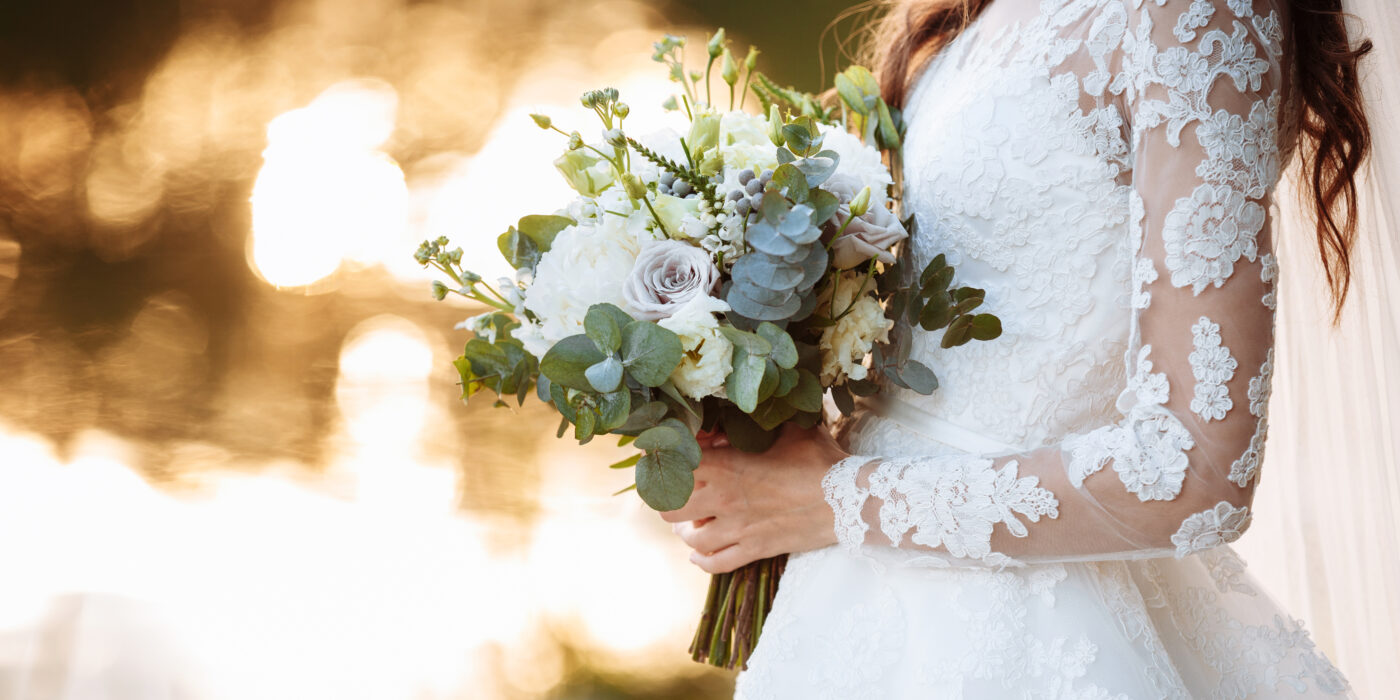
Intimate and Sophisticated Wedding Ceremonies: The Castle Opens at Minimony

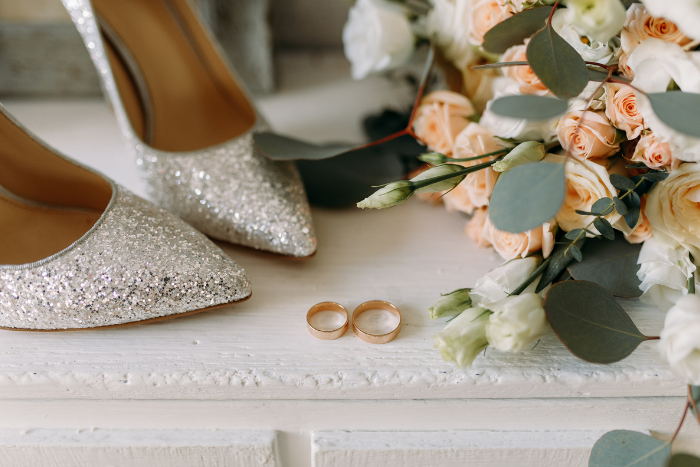
It is called minimony or micro wedding and is a trend that is increasingly in vogue among many couples, both Italian and foreign. Sharing the most important day of one's life with a very few, select guests, realising an intimate wedding ceremony but still paying attention to the smallest details.
Table of contents:
  1. Refined micro weddings
  2. The enchantment of small ceremonies
  3. The imposing Luzzi Hall
  4. Other corners and the garden

Minimony Refined

Many married couples today choose to celebrate their marriage in a reserved manner, with a small and particularly refined ceremony. However, this choice can present challenges, as many wedding locations impose a minimum number of participants, sometimes forcing compromises on the elegance of the event. The Castle of Torre Alfina decided to respond to this need by offering a unique opportunity to couples wishing to pledge eternal love during exclusive ceremonies with a small number of guests, thus realising the dream of a fairytale wedding.

Intimate and Enchanting Wedding Ceremonies

Immersed in the evocative beauty of a historic residence and away from the traditional crowded ceremonies, the Torre Alfina Castle happily offers the possibility of organising minimonies intimate and elegant. The bride and groom will have the opportunity to enjoy an unforgettable experience in a romantic and atmospheric setting. With customised packages and meticulous attention to every detail, our staff will strive to turn your intimate wedding into an unparalleled experience, making the magic of this dream location accessible to all. Moreover, if you choose a weekday for the ceremony (Monday to Thursday), you can access more favourable rates.

Ennio Luzzi Hall

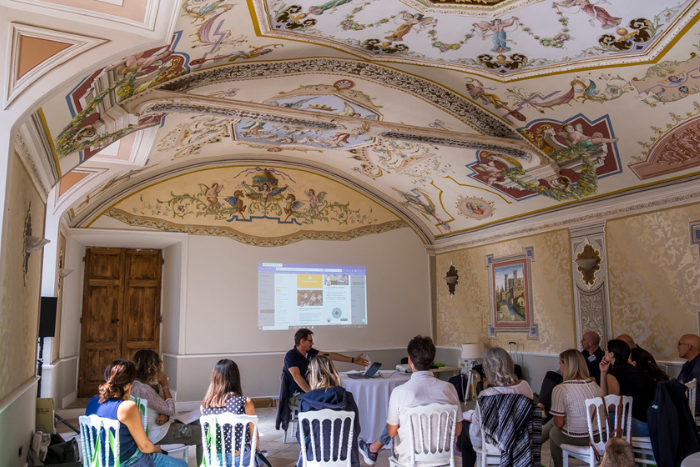
The bride and groom can choose between numerous picturesque corners within the castle to set up their ceremony, including the sumptuous Ennio Luzzi Hall, considered the main hall of the structure. This space represents an authentic artistic masterpiece steeped in history, the result of centuries of effort to preserve the essence and beauty of the castle. Commissioned in 1600 by the Monaldeschi della Cervara family, the Ennio Luzzi Room was magnificently decorated and frescoed by Cesare Nebbia. Later, in the early 1900s, it underwent an initial restoration by Pietro Ridolfi. Around 1990, Ennio Luzzi assumed responsibility for the restoration of the marks left by his illustrious predecessors, a commitment that earned him the posthumous naming of the hall. This room is ready to welcome newlyweds and their guests in an atmosphere of pure magic, offering an unforgettable experience for the most important day of their lives.

Evocative Corners and Renaissance Garden

In addition to the prestigious Luzzi Hall, newlyweds will have the opportunity to choose between various picturesque corners within the castle or the enchanting scenery offered by the renaissance garden. The latter, a refined Italian garden, enriches the open spaces of the castle and overlooks a breathtaking panorama. Here, the geometries of the hedges, the presence of a fountain with water features, flower beds and a secret garden make it possible to celebrate intimate ceremonies and to organise elegant and refined outdoor wedding banquets.

The Torre Alfina Castle offers a unique opportunity for couples wishing to realise an intimate wedding, without compromising the elegance and sophistication of the event. Ask for more information on how we can help make your minimony a reality, amid historic halls, Renaissance gardens and picturesque views that hide magical scenery, ideal for creating indelible memories.
en_GBEnglish (UK)