Marriage and traditions from the world

Marriage from the World: Traditions, Symbols and Rituals

Every marriage is a deeply personal act, but few events like weddings manage to speak a universal language. In different cultures, distant eras and geographical contexts, we find similar gestures, recurring symbols, rituals that resist time because they respond to common needs: protection, continuity, prosperity, belonging.
Table of contents:

Wedding Traditions in the World

Le best-known wedding traditions do not really belong to just one country: they are gestures that reappear, with different nuances, in many cultures around the world. They change the materials, the ways, sometimes even the words, but the message is almost always the same: to wish protection, prosperity and continuity to a couple who are starting a new life together. This is the reason why, when talking about matrimony, people from very different backgrounds still manage to recognise themselves in the same symbols.

Italy is among the most popular destinations for destination weddings. Getting married in our country does not mean choosing traditions far removed from your own culture: it means experiencing familiar rituals in a context that makes them even more intense.

Something Old, New, Borrowed and Blue

It is often considered an Anglo-Saxon tradition, but the custom whereby the bride has to wear “something old, something new, something borrowed, something blue” is now also rooted in Italian marriages, especially in international contexts.

Each wearable element responds to a precise symbolic function:

  • The old represents the continuity with the family of origin, a bridge between the past and the future.
  • The new symbolises the life beginning, the unknown opening up.
  • The loaned, ideally by a happily married person, symbolically transfers good fortune and stability.
  • The blue, a colour historically associated with the fidelity and spiritual purity, has its roots in medieval European symbolism.

The strength of this tradition lies in its adaptability: while maintaining an ancient symbolic framework, it allows for intimate and personal interpretations.

Do Not Meet Before the Ceremony

The custom that bride and groom should not see each other before the ceremony is widespread in much of Europe and the Anglo-Saxon world. Its origins date back to the arranged marriages of the Middle Ages, when the early meeting could call into question already established family alliances.

In Italy, as in France, England and the United States, this tradition has gradually emptied of its superstitious meaning, turning into an emotional ritual. Waiting becomes an integral part of the wedding narrative: the first glance is not just a private moment, but a symbolic passage marking the beginning of the new shared life.

White Dress and Rice Throwing

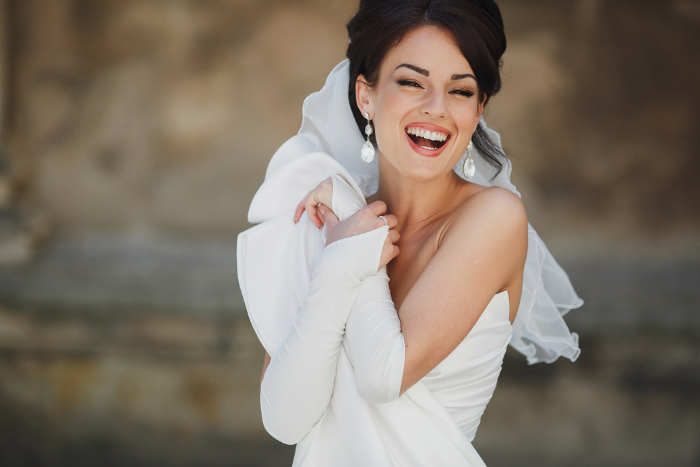
Contrary to popular belief, the white wedding dress is not an ancient custom. In Italy, as in the rest of Europe, it spread from the 19th century, after the marriage of Queen Victoria of England in 1840. Since then, white imposes itself as the colour of the solemn celebration, rather than as a moral symbol. Today it is a language shared in much of the western world: a visual sign indicating the exceptional nature of the event and its ritual value.

Rice throwing at the exit of the ceremony is a widespread tradition not only in Italy, but also in Asia, the Mediterranean and the Americas. The rice, a staple food and symbol of nourishment, has always been associated with the idea of prosperity, fertility and abundance. While today it is often replaced by petals, grain or natural elements, the gesture retains its augural valuesymbolically accompanying the couple in the transition to a shared fertile life.

Wedding Rings and the Amoris Vein

Lo exchange of rings is one of the oldest and most universally recognised gestures of marriage. In Italy, as in France and the United Kingdom, the wedding ring is worn on the ring finger of the left hand, according to the Roman belief in the vena amoris, a vein that would directly connect the finger to the heart. Even in countries where the ring is worn on the right hand, the symbolism remains unchanged: the circular shape represents eternity, the absence of beginning and end. It is a sign that can be understood in every culture, precisely because it speaks a primordial language.
In Italy, wedding rings are often blessed during the ceremony and kept in a carefully chosen wedding ring holder, a detail that combines rituality and intimacy. In many families, moreover, the ring becomes a line item handed down from generation to generation testifying to continuity.

Crossing the Threshold Together: A Gesture of Protection

Lifting the bride over the threshold of her new home is a tradition in Italy, Germany and the Anglo-Saxon world. Its origins are linked to superstitionStumbling on entering the house was considered a bad omen.
Today this gesture survives as a symbol of mutual care and protection, often charged with poetry and iconographic value. It is one of those rituals that, despite having lost its original function, continues to be handed down for their evocative power.

Paying Something: Only Italian Tradition?

The idea of the groom symbolically paying something on the path to marriage is a tradition more typically Italian and Mediterranean, today often surviving in a joking form or as a folkloric echo. In some areas of Italy find themselves community-related variantssmall impromptu tolls (a coin, an offered toast, a goliardic test), or ritual gestures that emphasise the groom's entry into the world of the new family. The original meaning referred to an ancient logic of negotiation and social exchange, when the marriage also had an economic and alliance function between family units.
In Germany and several Eastern European countries there is a similar tradition, declined in an ironic and convivial key: in the days leading up to the wedding, the groom's friends symbolically “kidnap” the bride and take it with them between clubs and hangouts. It will then be task of the groom to track them down and offer them a drink or settle the bill. A ritual that today is entirely folkloric, shared and consensual, transforming an ancient symbolic logic into a moment of play and sociability.

Same Traditions in Timeless Places

What makes these traditions particularly powerful in destination weddings is their cultural recognisability. Couples from different countries may recognise themselves in the same gestures, while celebrating them in a new context.

This is where historical Italian locations, such as the Torre Alfina Castle, capable of offering a authentic frame to shared rituals. The history of the place does not overpower the ceremony, but gives it depth, transforming each gesture into a timeless act.

In contemporary marriage, tradition is no longer an obligation, but a choice. It selects, it adapts, it reinvents itself. What counts is the meaning that the gestures take on for the couple. And it is precisely this freedom, combined with ancient and universal symbols, that makes marriage in Italy an experience capable of speaking to everyone, everywhere.

Special Events at the Castle

5 Reasons to Choose Torre Alfina Castle for Your Event

Organising an event is not just about finding a location, but choosing a place that can tell a story and create a memorable experience. The Torre Alfina Castle, with its walls laden with centuries of history, offers an atmosphere that turns every occasion into a journey through time.

From the elegance of the frescoed halls to the charm of the ancient prisons and the timeless beauty of the Renaissance gardens, this castle is much more than a scenic backdrop: it is a place to live. Here are five reasons why this medieval fortress is the ideal choice for those seeking an authentic and unforgettable experience.

Table of contents:

1. Castle with a Soul: History, Art and Tradition

The Castle of Torre Alfina is not just a majestic medieval building, but a silent witness to centuries of history. Its origins go back to the Middle Ages and over time it has been a noble residence, a strategic stronghold and a cultural centre. Today, passing through the entrance gate, it is still possible to perceive the charm of a bygone era, enriched by architectural and artistic details of extraordinary beauty. Like the majestic medieval walls that guard centuries of secrets and legends of the people who lived here. And also the frescoed halls and the historical furnishings that tell stories of bygone eras. Finally, the Renaissance gardens offer an elegant and refined setting. Here an event is not just a special occasion, but an experience that intertwines past and present, creating a unique and unrepeatable atmosphere.

2. Place of Emotions and Sharing

Whether it is a matrimonya party or a company meeting, an event is about relationships, emotions and moments to remember. The Castle of Torre Alfina, with its varied spaces and evocative atmosphere, favours an immersive, immersive experience. But what makes an event here special? Certainly the feeling of crossing the threshold of time, immersing oneself in a atmosphere charged with experience, leaving the daily hustle and bustle outside. An authentic location, capable of creating bonds and connections. And then certainly the dialogue between nature and architecture, with indoor and outdoor spaces that integrate harmoniously
Whether it is an intimate ceremony in the castle halls, a reception in the outdoor courtyard or an atmospheric evening under the starry sky, every moment here takes on a special value.

3. Tailor-made Experience in a Versatile Location

La versatility of the structure and theStaff resourcefulness makes it possible to create events that not only make the most of the potential of spaces, but also make them protagonists, creating an immersive and unique experience for participants. An example? The former castle dungeons. Where prisoners and political opponents were once locked up an Escape Room was set up, perfect for those seeking an exciting challenge in an environment that awakens the imagination and stimulates collaboration. In addition to being one of the castle's most atmospheric experiences, this space is available for private eventsallowing intimate dinners or themed parties to be organised in a highly evocative setting.

4. Combination of Past and Present

The interplay between the fascination of the past and the dynamism of the present offers a rare opportunity to experience and appreciate history in a direct and engaging way. Historical residences, such as the Torre Alfina Castle, are more than just places to visit: they are silent witnesses of centuries of events, traditions and changes that have shaped the culture and identity of our region. Integrating modern events in historic locations not only protects our past, but also guarantees vitality in the future, celebrating local culture and offering new generations an immersive experience in history. In this way, the castle becomes more than just a memory: it is a place that nurtures the culture and creativity of the present, establishing a continuous dialogue between eras.

5. Suspended Time Telling Ancient Stories

There are places that, once crossed, are etched in the memory forever. In a medieval castle every stone, every architectural detail has something to whisper. It is not just the grandeur or beauty of the spaces, but the atmosphere that pervades the rooms as soon as you enter.

Those who choose the Torre Alfina Castle for their event do not only choose a location, but a complete sensory experience, made of sounds, lights and emotions that make this place truly extraordinary. Sunset tinges the walls and the silence of exquisite Renaissance-style gardensinterrupted only by the blowing of the wind through the ancient stones and the foliage of the trees in the forest below. Towers and battlements dominating the surrounding landscape, evoking the image of knights and ladies who once inhabited them. A journey through time that allows you to experience the magic of the past in a setting that combines history, beauty and charm.

Bridesmaids of the Bride

Bridesmaids: the Origins of Tradition

What is one of the greatest emotions for a bride? Having at your side friends, sisters, cousins to whom you give a special role on the most important day of your life. We are talking about the bridesmaids of the bride, practical and emotional support figures from the planning stages of the wedding, right up to the big day. A major role among bridesmaids is also played by the maid of honour.
Table of contents:
  1. The origins of tradition
  2. In Italy an imported tradition
  3. The role of bridesmaids in Anglo-Saxon tradition

Bridesmaids: Ancient Origins of Tradition

The tradition of accompanying the bride towards her dream of love has very ancient origins. It dates back toAncient Egypt, when it was believed that on the wedding day, the evil spirits could prevent the bride from realising her happiness. It was therefore customary for a group of at least ten women to wear dresses similar to the bride's wedding dress, to confuse and throw off evil spirits. This belief was also echoed in Ancient Rome, and from the Renaissance onwards, throughout Europe, the number of young women, often single, helping the bride and accompanying her up to the moment of the ceremony, was all the greater as the economic and social power of the bride's family.

Brides and Bridesmaids in Italy: a Modern Tradition

The figure of the bridesmaid (o bridesmaid) and bridesmaids in general was imported from the United States to our country only very recently. Until some 50 years ago, the Italian bride surrounded herself with pageboys and bridesmaids, i.e. children particularly close to the bride and groom who performed certain tasks during the ceremony. The bridesmaids, two to six, wore clothes of the same model differentiated at most by colour. Same number for the page which were to be dressed up and one of them usually had the role of carrying the wedding rings down the aisle. Most important role in Italy they had, and still have, the bride and groom's witnesses. The bride still chooses a friend, a sister or a person close to her who, however, usually has no particular tasks to perform. In contrast to the Anglo-Saxon world, where the role of bridesmaids and maid of honour is taken very seriously.

Bridesmaids and Maids of Honour in the Anglo-Saxon World

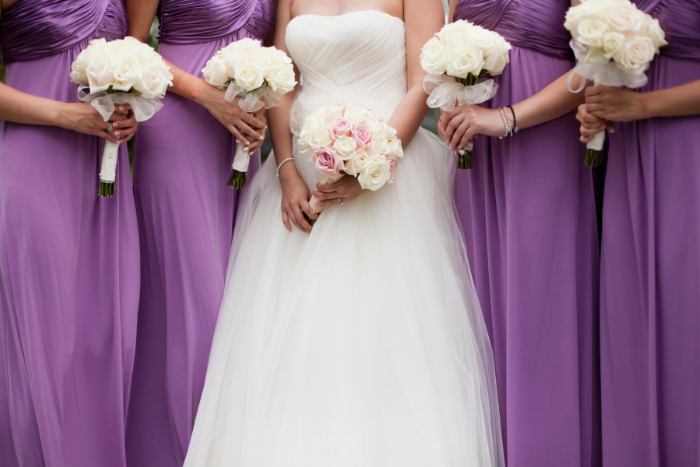
In USA and the UK the tradition of bridesmaids is very well established. The wedding procession consists of the "bridesmaids' and the 'maid of honour' as key figures. Bridesmaids have the very specific task of advising the bride in her choice of dress, following her through all the stages of wedding preparation, helping her to dress and relax during the big day. They also have the role of opening the wedding procession, behind the maid of honour, and flanking the bride at the altar. The bridesmaids must also wear a dress of the same colour, carefully chosen by the bride according to her taste.
The bridesmaid performs a fundamental role in the wedding preparations and celebration. During the ceremony co-ordinates pageboys and bridesmaids. She is the first to enter the church, in front of the bridesmaids, holding a small bouquet of the same floral arrangement as the bride's. During the ritual, it deals with settle the dress and veil of the bride. During the course of the banquet, she is ready to intervene to handle any unforeseen events, while maintaining a discreet profile so as not to overshadow the star of the event. Anglo-Saxon tradition suggests that la bridesmaid meets her future husband at her friend's wedding.

The influence of the Anglo-Saxon world is now also being felt in Italy. More and more Italian brides are choosing to replace bridesmaids and groomsmen with big bridesmaids (adult) and one bridesmaid. Finally, a curiosity: how many bridesmaids you can have? According to the etiquettenever more than eight and always in numbers even. The only exception: the gift weddings (in this case you can go as far as twelve).

wedding dress

Wedding Dress Trends 2024

As the year comes to an end, numerous fashion shows and bridal fairs have shown us what the trends for 2024 will be in terms of bridal gowns and more. First and foremost, Barcelona Bridal Fashion Week, one of the most eagerly awaited events in the sector, where many world-famous brands have decided to bring their gowns to the catwalk, marking once and for all what will certainly be the bridal trends 2024.

Table of contents:
  1. No to excess, yes to elegance
  2. A luminous bride
  3. Style and practicality
  4. Change of clothes with dual-dress

Less Volume, More Elegance

A key role in the success of a perfect marriage is the choice of wedding dress. One of the most obvious trends for wedding dresses in 2024 is the volume reduction. Many of the creations that will be on trend are characterised by cleaner, tighter lines with a focus on enhancing the silhouette of the bride. Goodbye to excessive layers of tulle and wide skirts, next year promises to be the year of simplicity and elegance.
Brands such as Yolancris, Jesús Peiró, Isabel Sanchis and Sophie et Voilá are promoting this trend with dresses from the straighter lines, petticoat cuts, sheath dresses, empire dresses and more sober lines. The aim is to bring out the bride's natural beauty, putting her figure in the foreground.

Dresses with Diamonds: A Bright Continuation

Started in 2023, the trend of bridal gowns with diamonds will be further consolidated in 2024. Brides will literally be sparkling stars on their special day. Designers are making dresses with shiny fabrics or completely covered with sparkling stones, from the largest to the smallest. Luxury and opulence are sure to take centre stage. These wedding dresses become true jewels, putting the bride at the centre of attention and creating a magnet effectno one can take their eyes off her. Shimmering gowns feature glittering details on bodices, skirts, veils, sleeves, capes and even the train. This trend is perfect for brides getting married in the evening or in sumptuous locations such as historical residences or villas with a sea view.

Mini Dress and Party Dress: The Bride Dresses with Style and Comfort

Short wedding dresses are nothing new in the bridal world, but in the coming year they will play an even more central role. Many fashion houses are proposing short dresses, some just above the knee and others true mini-dresses. This year's special feature is the train at the back, which can be attached and detached as required, creating a double look that suits different stages of the wedding. From Yolancris, with its bold mini-dresses, to Jesús Peiró who adds tulle details to skirts, to The Atelier, Elie Saab, Demetrios, Nicole Couture and Woná Concept, all are proposing short wedding dresses with a modern, sensual and lively cut. These 'party dresses' are ideal for young, determined brides who want to feel like queens on their day without sacrificing comfort.

Dual-Dress: Effortless Changing of Dresses

And speaking of comfort, the trend that won't go away is the dual-dress. Many designers are creating clothes with detachable skirts, allowing the bride to make a unique dress change without necessarily having to buy two different models. Generally, the removable tail is made of tulle, but there is no shortage of fully feathered models or very wide ones covered with ruffles. Imagine wearing thefull dress at the ceremony and then to remove the back train during the reception or the final party, so you can show off your mermaid dress in all its splendour. This smart and versatile choice will allow you to fully enjoy every moment of your wedding.

2024 will be a year of great creativity and diversity in the world of wedding dresses. So, if you are planning your wedding for next year, remember to keep these trends in mind when choosing your dream dress. Whether you prefer simplicity, glitz or a festive look, there is sure to be a dress that will make your beauty shine on the most important day of your life.

en_GBEnglish (UK)