Detail of the Castle frescoes

Details to Observe at Torre Alfina Castle: Bullets, Blackbirds and Frescoes

The details of the Torre Alfina Castle help to read its history at close quarters. Some are decorative, others architectural, and still others preserve harder traces, linked to the events of the 20th century. During the visit, stopping in front of these elements allows one to discover a less immediate story, made up of symbols, political signs, artistic memory and wounds left in stone.

Table of contents:

Each castle speaks through its halls, towers and overlooks. The Torre Alfina Castle also speaks through details more minute: the bullet marks in the lower gallery, the decorated doors, the Guelph battlements, the frescoes by Pietro Ridolfi. These are different elements, perfect for snapshots details that help tell the story of the stratification of the place.

Bullets on the Lower Gallery Wall

Among the most intense details of Torre Alfina Castle to observe are the bullet marks on the wall of the lower gallery. They are material traces of a past marked by war, remaining visible as wounds in stone. In 1943 the Torre Alfina Castle became the headquarters of the Todt Organisation, a German paramilitary group in charge of the construction of the Gustav Line, the mighty defensive line wanted by Hitler to hinder the Allied advance along the Italian peninsula.

In the heart of the lower gallery, those signs are reminiscent of the firefight occurred during the passage of the French troops that contributed to the liberation. The stone thus preserves a precise memory: that of a time when the Castle was traversed by military history, the tension of the conflict and the passage of men involved in the events of the Second World War.

Observing these signs means encountering a part of the castle far from the more scenic image of the historic residence. Here the narrative passes through a raw, direct, visible trace. The bullets on the wall remind us that even the most fascinating places can hold difficult memories. They are signs that speak and invite awareness.

Decorated Doors: Thresholds that Tell a Story

The decorated doors of Torre Alfina Castle deserve a close look, because they transform a functional element into a narrative surface. Made by the Sienese cabinetmaker Tito Corsini in the early decades of the 20th century, these doors accompany the interior with carvings, symbols and thematic references. Each door introduces a small figurative universe. There are doors related to heraldry, nature, music, the sea, fruit, Siena and Torre Alfina itself. The Heraldic Gate recalls the language of coats of arms, families and memberships. The so-called fishing gate presents instead a more curious and allegorical scene, with winged cupids armed with tridents intent on catching a dolphin. Other doors preserve themes, dates, places and decorative signs that make each threshold different from the previous one.

Craftsmanship, symbolism, family memory and scenic attention can be found in the carved panels. They are physical and narrative thresholds, capable of accompanying the visitor from one environment to another, allowing the character of the Castle to emerge.

Guelph Blackbirds and Ghibelline Blackbirds

Even the battlements of a castle can tell a story stories of alliances, battles and political symbols. The battlements, often observed as a decorative or defensive element, actually contain a recognisable language.

  • The Guelph blackbirds have a square shape and are traditionally associated with cities loyal to the Pope. They are typical, for example, of cities like Florence.
  • The Ghibelline battlements, instead, are shaped like a swallowtail, resembling an inverted V, and identified supporters of the Holy Roman Emperor. They are widespread in cities such as Siena.

The Castle of Torre Alfina proudly displays the Guelph battlements on its towers. It is an architectural detail that reveals much about its past and the symbolic language through which castles communicated belonging, power and political position.

To look at the battlements is therefore to read the profile of the castle with greater awareness. The shape of the stone becomes a sign. The tower narrates its defensive function, but also the system of political and cultural references into which the castle was inserted. It is one of those details that, once recognised, change the way one looks at the entire structure.

The Frescoes of Pietro Ridolfi

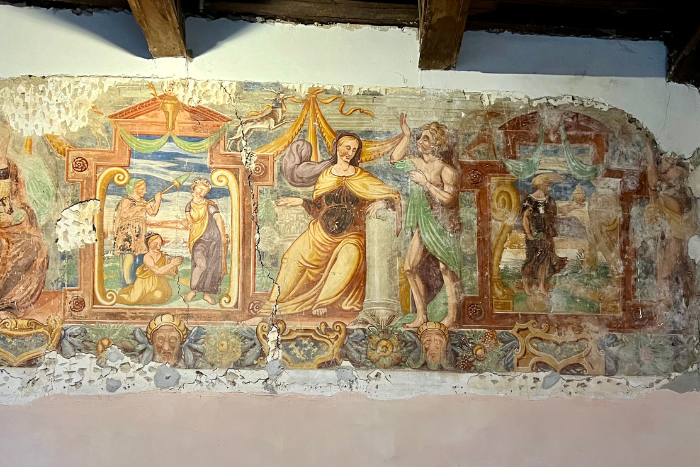
Another element to be observed carefully is the decorative cycle linked to Pietro Ridolfi, a painter specialising in mural tempera, who was called to work at the Castle in the early 20th century. In 1906, Rodolfo Cahen entrusted him with the decoration of several rooms, thus leaving an important trace in the rooms of the residence. Among the most interesting works are the Four Seasons frescoes, still preserved in the noble gallery. The theme of the seasons brings into the Castle a tale of time, nature, transformation and landscape. Spring, summer, autumn and winter become images through which the dwelling dialogues with its surroundings.

A particularly significant detail concerns the Spring sketch. Ridolfi had initially imagined the sea as a symbol of rebirth. However, Rodolfo Cahen pointed out to him that the sea was not visible from Torre Alfina. The artist then replaced that element with a tin, maintaining the suggestion of water and making the scene more consistent with the landscape of the place.

This episode tells well the relationship between art and context. The Castle's frescoes were not created as simple decoration, but as dialogue between the imagination of the artist, the will of the patron and the identity of the territory. Here too, detail becomes the key to interpretation: a pond instead of the sea may seem a minimal choice, but it reveals attention, listening to the place and a desire to construct a visual narrative consistent with Torre Alfina.

Visiting the Castle through Details

The projectiles in the lower gallery, the decorated doors, the Guelph battlements and the frescoes by Pietro Ridolfi show four different ways of reading the Torre Alfina Castle. The memory of war, etched in stone, handicrafts that transforms thresholds into stories, architecture of the towers, capable of communicating political affiliation. And finally the painting, which brings the time of the seasons and the relationship with the landscape into the halls. During the visit, these details invite you to slow down. A wall can become historical testimony. A door can reveal a symbol. A tower can tell of an alliance.

Recognising the details of Torre Alfina Castle means enter a deeper narrative, in which each sign adds a voice to the story of the place. This is also how the castle is discovered: through details that seem secondary and that, observed from close up, open up wider stories.

Photographs Castle Torre Alfina

5 Must-Do Photographs at Torre Alfina Castle

The Torre Alfina Castle is one of those places that seem born to be photographed. Not only for its impressiveness, but for the quantity of architectural details, scenic views and atmospheres that make it unique among Italian castles. Every nook and cranny tells a story: that of the Monaldeschi, the Cahen, the architectural transformations that made it the elegant and fairy-tale residence we know today.
Table of contents:

1. The Castle Appears Between the Houses of the Village

So, what are the photo shots you should definitely take during a visit to Torre Alfina Castle and the village of the same name? Let's find out together.

The first shot comes even before entering the castle. Arriving at Torre Alfina, the village slowly accompanies the gaze towards his majestic presence. The castle appears among the roofs and stone facades, almost like a theatre backdrop. The dark stone of the walls, contrasting with the sky and the village, creates a very strong visual effect: the viewer immediately perceives that he is in a special place.

This is the shot of the “first meeting”.
It is not a photography technique, but emotional: encapsulates the surprise, the suggestion, the perception of entering a dimension suspended between history and fairytale.

Photographic advice:
He deliberately leaves part of the village in the framea street, an arch, a façade. It will be the best way to tell the deep connection between castle and country.

2. Framing Glimpses: Alleys, Installations and Unexpected Perspectives

One of the most fascinating ways to photograph the Torre Alfina Castle is to look for it. Walking through the narrow alleys of the Borgo di Torre Alfina, the Castle appears and disappears as in a play of perspectivesnow framed between two stone façades, now perfectly aligned with an ascending street, now silhouetted against the sky with its imposing towers. Each corner offers a different view, almost as if it were a natural set designed to enhance its profile.

But that is not all. The village is enriched by art installations contemporary that add a touch of irony and creativity to the historical context. Among the most curious are legs and a hand sticking out of the roof of a house, or the faces in terracotta lying on the wall of a house: mute expressions that seem to observe passers-by, creating a discreet dialogue between art and everyday life.

Here photography becomes storytelling. The Castle is not an isolated subject, but part of an ecosystem of history, widespread art, creativity and village life. Each shot thus becomes a small painting, where ancient and contemporary coexist in perfect balance.

Photographic advice:
Use arches, doorways and perspective lines of alleys as natural framesThey will guide the eye towards the towers and enhance depth and composition.

3. The Guelph Towers and Merlons: Architecture Becomes Storytelling

Among the most fascinating details of the Torre Alfina Castle are undoubtedly its towers. If you look at them carefully, you can see the presence of a very specific crenellation: the Guelph battlements, recognisable by their square shape. An architectural element that is not only aesthetic, but symbolic.

In the Middle Ages, castle profiles also spoke of politics, alliances and affiliations.
The Guelph blackbirds identified the supporters of the Pope and distinguished themselves from Ghibelline blackbirds, dovetail, symbol of loyalty to the Holy Roman Emperor. A clear and powerful visual code, so much so that entire cities, such as Florence and Siena, have become famous for their “biased” battlements.

The Castle of Torre Alfina proudly displays its Guelph battlements on the towersan indelible sign of the history of the territory, the power relations and political identities that have passed through it. Photographing them means immortalise not just an architectural detail, but a fragment of collective memory.

Photographic advice:
Choose a bottom-up perspective and let the sky be the background: the line of the battlements will be sharp and recognisable, transforming your image in a true historical narrative.

4. Decorative Details: Coats of Arms, Portals and Neo-Gothic Elements

The castle is not only impressive for its architectural mass, but also for the numerous decorative details introduced during the restyling commissioned by the Cahen family. Portals, windows, cornices, neo-Gothic decorations: an elegant weave that tells of the 19th century taste for historical and romantic revival.

This is the shot that demands attention and slow gaze. The carved coat of arms, a framed window, a wrought iron or stone decoration: every detail speaks of noble life, of illustrious personalities, of the idea of beauty and representation that the Castle had to communicate.

Photographic advice:
Island detail with a soft background: the texture of the stone will take centre stage.

5. The View of the Valley: the Castle as Sentinel of the Territory

The Torre Alfina Castle is not just a historical residence: it is a vantage point on the landscape of Tuscia and upper Lazio. Its perspectives open up a wide and silent view of the valley, woods and hills surrounding the village. It is a shot that narrates the relationship between architecture and territory, between man and nature.

Here, photography becomes contemplative.
The feeling is that of standing on a threshold of timebehind, history carved in stone; in front, the open breath of the landscape.

Photographic advice:
Choose morning or late afternoon hoursThe grazing light will add depth and poetry.

Shoot to Remember, Visit to Live

These five shots are not just images: they are fragments of experience. They tell a castle that does not live on postcards, but on atmospheres, details, perspectives and stories. To photograph it is to freeze an instant, but above all to create an emotional bond with the place.

E the best way to discover new shots is to visit again.
Because each time, the Torre Alfina Castle will show itself in a different light.

Lake Bolsena

Journey through Alta Tuscia amidst Tastes and Authentic Landscapes

Visiting the Torre Alfina Castle can be a perfect opportunity for an exciting out-of-town visit in Alta Tuscia. An experience that continues beyond the walls, where Lazio, Tuscany and Umbria meet in an area where art blends harmoniously with nature. Among the stone alleyways of ancient villages, enchanted woods and tables laden with genuine flavours, every step turns into a pleasant discovery of living traditions and small treasures that make Alta Tuscia a unique land.
Table of contents:

Strolling through the Lanes and Stopping to Taste

After exploring the castle and breathed in the suspended atmosphere of its halls, the journey continues in the medieval village that surrounds it. Walking through the narrow streets of Torre Alfina is like slowing down time: stone walls, flower-filled balconies, sudden glimpses that catch the eye. Here the workshops offer mature cheeses, cured meats with an intense aroma, bread baked in a wood-fired oven and desserts that tell family recipes handed down from generation to generation. The village is also famous for the spelt from the Pungolo of Acquapendenteancient and versatile ingredient, the St. Anthony's biscuit and the typical 'imbriachelle'rustic doughnuts to dip in wine to close the meal with a a simple gesture but full of tradition.

Recipes That Tell Stories

Sitting down to eat in these lands means savouring dishes that carry with them the memory of those who handed them down. Like acquacottaa humble but richly flavoured soup made with stale bread, field vegetables, potatoes and a poached egg that binds everything together delicately. Or the lombrichellihandmade fresh pasta, thick and rough, ideal for holding firm sauces such as amatriciana or cacio e pepe. Dishes that speak of home, burning fires and family Sundays and which still today tell the history of a sincere peasant cuisine.

Wines that Smell of Hills

Next to the dishes, can't miss the wines that make this land special. A glass of Grechetto, a fresh white with fruity hints, perfectly accompanies hors d'oeuvres and vegetable dishes. The Ciliegiolo, a soft and light red, is perfect with rustic first courses or white meats, while theAleatico di Gradolisweet and aromatic, it provides the perfect finish with dry desserts or mature cheeses. Small local wineries offer tastings that become authentic encounters with those who have been cultivating vines for generations, transforming wine into narrative.

Places that Enchant Nearby

Our journey of discovery in Alta Tuscia can continue a few steps from the Castle of Torre Alfina, in the Sasseto Monumental Forest. An almost magical place where centuries-old trees, moss-covered volcanic boulders and hidden paths create a fairytale atmosphere.
Continuing southwards, about half an hour's drive away, the pretty village of Bolsena welcomes visitors with its mighty Rocca Monaldeschiwhich dominates the historic centre, and the lake of the same name, the largest volcanic lake in Europe offering unforgettable sunsets.
On the south-western shore of the lake, some historic centres hold suggestive views and memories of art. Capodimontewith the bulk of the Palazzo Farnesea majestic architectural work commissioned by the noble family in the 15th century, alleys, small squares and panoramic views of the lake. Only 3 km away, the village of Martaalso known as the "Borgo dei Pescatori' tells its story between the beautiful lakeside promenade, the Clock Tower symbol of the town, the Collegiate Church of Saints Blaise and Martha and the impressive Grotto of Apparitions, a place of popular devotion which adds a spiritual touch to this lakeside walk.

An Invitation to Slow Tourism

A day in Alta Tuscia thus becomes much more than a visit: is an experience that combines history, taste and landscapes that remain in the heart. Among ancient dishes, genuine wines, charming villages and places suspended between nature and legend, every moment tells something about this land. Just let your curiosity guide you and take the time to experience the emotions. Because every experience is a gift to be welcomed with the senses and cherished with the soul.


Court Life

Court Life at the Castle: How People Lived in the Middle Ages

During the Middle Ages, a castle was not only a defensive fortification, but also a vital centre, a microcosm reflecting the society and culture of the time. Every day, within the robust walls of a medieval castle, stories of power, intrigue and complex social relations were woven. The Torre Alfina Castle stands as a living testimony to medieval life, with its daily routine of strategies, duties and moments of great pomp.
Table of contents:

A Typical Medieval Day

How people lived in the Middle Ages? And, in particular, how was the life in medieval castles? The castle came alive at dawn: the bells called servants and ladies to their daily tasks. The knights practised in the courtyardpreparing for possible battles or tournaments, while the ladies supervised the running of the mansion. The lord of the castle, meanwhile, was in charge of of land administration and political issues.

In the afternoon, the courtyard could turn into an arena for knightly tournamentsevents that not only entertained, but also served to strengthen alliances and prove the valour of knights. But there was no shortage of intrigue: medieval castles were also places of alliances and conflictswhere political and family relationships were mixed with games of power and cunning. The day usually culminated with convivial banquetsduring which political strategies were discussed and family ties strengthened.

The Role of the Ladies in the Castle

La checkers of the castle played a key role in the daily housekeeping and child-rearing. In addition to domestic tasks, women were often engaged in theland administration, resource management and easement supervision. In the absence of the lord, they could even hire responsibility for the defence of the castlecoordinating the protection of the walls and ensuring supplies during possible sieges.
Their skills in embroidery, weaving and the arts were appreciated, but also their political intelligence could make a difference at critical moments. Ladies actively participated in marriage strategies, often used to strengthen alliances between families. Some of them exerted great influence in political affairs, advising husbands and sons on matters of politics and diplomacy.

Medieval Dinner: Recipes and Curiosities

Medieval cuisine in the Torre Alfina Castle reflected the resources available in Tuscia Viterbese. During banquets, they served local game meat, such as wild boar and hareaccompanied by spicy sauces. Spices, often imported, were a sign of prestige and used to flavour and preserve food. The wine, produced in the nearby hillswas the main drink, while sweets, such as honey and fruit cakes, were a luxury reserved for special occasions.
Among the medieval recipes of Tuscia, handed down and still widespread today, we find acquacottaa soup of peasant origin prepared with seasonal vegetables, stale bread and sometimes eggs or cheese. In the confectionery tradition of Viterbo, one then finds the mortarioli, honey biscuitsalmonds and cinnamon, of medieval origin, appreciated even by St Francis.

How the Castle of Torre Alfina was Defended

The defence of Torre Alfina Castle was based on strong walls, watchtowers and a strategic location on high ground. The knights wore heavy armour and used swords and spears in battle. Bows and crossbows were employed for long-distance defence. But defence was not only limited to physical battle: other stratagems were common. Medieval castles were designed to survive long sieges: the wells for water and food supplies were essential to withstand prolonged periods without supplies. Some castles, such as Torre Alfina, also had secret passages and hidden chambersto protect the lord's family in the event of an attack.

Living in the Castle of Torre Alfina during the Middle Ages meant immersing oneself in a reality of fascination and responsibility. The life in the medieval castle was not only about parties, banquets and tournaments, but also about sacrifices, duties and everyday life. Today, by visiting this magnificent fortress in Tuscia Viterbese, we can relive the stories of those who lived there and appreciate the cultural heritage they left us.


en_GBEnglish (UK)