Moai Vitorchiano Statue: History and Curiosities
A few kilometres from Viterbo lies Vitorchiano, the splendid village in the Tuscia region perched on volcanic rocks. Here stands an extraordinary Moai statue, created in 1990 by sculptors from Easter Island using local peperino stone.
Table of contents:
- What is a suspended village
- What is the Moai of Vitorchiano
- What a Moai looks like
- Where is the Italian Moai
Just fifteen minutes by car from Viterbo, stands Vitorchiano, an ancient village and historical jewel set among the volcanic rocks of Tuscia. Considered one of the most evocative historic centres in the province of Viterboalso enjoys the prestigious accolade of one of the "most beautiful villages in Italy“. And it is precisely here that one of Tuscia’s most astonishing monuments is to be found: a Moai carved directly by local craftsmen Rapa Nui, a testament to a cultural encounter between this village in Lazio and the distant Easter Island.
What Borgo Sospeso means
The integrity of its ancient core, the dwellings that seem to blend harmoniously with the peperino cliffs on which they are erected, give Vitorchiano its distinctive appellation: the Borgo Sospeso. The origin of this name lies in the unique geology of the area. Deposits of volcanic material, shaped over millennia by volcanic activity, have created the imposing cliffs on which the villages of Tuscia. However, what makes Vitorchiano truly special is its peperino bank, fractured into enormous boulders, on which the buildings of the village rest directly. This peculiarity creates a fascinating visual illusion, making it seem as if the village has been carved into the rock. The houses, clinging and overhanging, merge with the lava rock, creating a perfect harmony with the Vezza Valley and the surrounding landscape, rich in oak, ash, beech, elm and chestnut forests.
What is the Moai of Vitorchiano
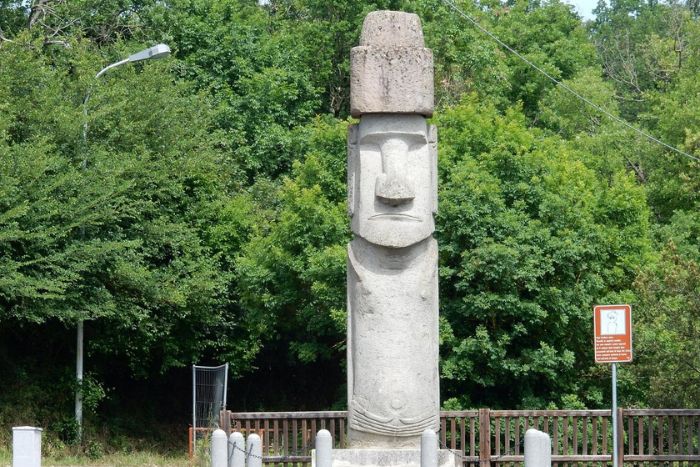
And it was precisely the abundance of peperino that made Vitorchiano the perfect place to build a gigantic Moai statue. The Moai statues are anthropomorphic monoliths carved by the indigenous Polynesian population Rapa Nui (which is also the original name of Easter Island), mostly between 1100 and 1500. They are veritable stone giants up to 21 metres high, probably augural monoliths bringing wellbeing and prosperity wherever they look. The Moai of Vitorchiano was built in 1990 by the Atan family, originally from Rapa Nui and consisting of 19 people. The occasion for the construction of the Vitorchiano monolith was the RAI television programme 'In Search of the Ark' by the journalist Mino D'Amato. Intent on promoting the restoration of the Easter Island Moai, the journalist was looking in Italy for a stone that was as close as possible to the volcanic stone from which the giants of Rapa Nuiwith which to create an Italian Moai. Vitorchiano, home of the peperino, was identified as the ideal place to realise the work, and the Atan family the right craftsmen.
What the Moai of Vitorchiano looks like
Over the course of several weeks, the sculptors of the Atan family created the Moai by carving a large block of peperino, drawing inspiration from the traditional techniques used on Rapa Nui. From an artistic point of view, the Moai of Vitorchiano It bears witness to the skill and mastery of the sculptors. Faithful to the originals, the statue features deep grooves, bold, simple and linear lines, and meticulous details such as the long ears, the emphasised navel and the tapered hands resting against the abdomen. The Moai of Vitorchiano is a particularly significant example: unlike the ancient monoliths transported from Easter Island and now housed in various museums around the world, this statue was carved directly in Italy by Rapa Nui artisans, using a local volcanic stone. Its value therefore also lies in the history of its creation, symbolising a meeting of artistic traditions and geographically distant cultures.
Where the Moai of Vitorchiano is located
The Moai statue has gone through various locations over the years. First located in the centre of Piazzale Umberto I, in 2007 it was temporarily transferred to Sardinia to be displayed in an exhibition of pre-Columbian art. Returning to Vitorchiano after nine months, the statue found its definitive location on Largo Padre Ettore Salimbeni, in the municipality's camper van area that overlooks the suggestive belvedere of the "Borgo Sospeso“.
The Moai of Vitorchiano, with its imposing presence and fascinating history, stands as an icon of one of Italy's most beautiful villages, representing a unique link between the millenary history of Easter Island and the timeless beauty of Vitorchiano, the suspended village of Tuscia.
Article updated on 26 October 2026 with some historical clarifications regarding the presence of Moai outside Easter Island.
 English (UK)
 Italiano