The Castle of Torre Alfina Living Room of Illustrious Personalities

The Torre Alfina Castle has spanned the centuries, hosting the lives of illustrious personalities and becoming a guardian of history, art and culture. Its walls tell of distant epochs, of battles and transformations, but also of intellectual encounters and artistic ferments that have enriched its charm.
Table of contents:

Cultural Crossroads in Tuscia Viterbese

Towards the late 19th century, under the leadership of Marquis Edward Cahen d'Anvers and later his son Rudolf, the castle experienced a season of splendour. The Cahen familycultured and cosmopolitan, transformed the residence into a true crossroads of ideas, artistic exchange and cultural production. This spirit of openness and patronage has left traces that are still visible within the walls of the castle and in the stories associated with the figures who frequented it.
Here is some of the illustrious personalities documented who have passed through the castle gates or left an indelible mark there.

Gabriele D'Annunzio: the Vate and the Castle

The name of Gabriele D'Annunzio is one of the most surprising of those linked to the Torre Alfina Castle. A guest of Marquis Rodolfo Cahen, D'Annunzio collaborated with him on the production of the play Dream of an autumn sunsetfor which he wrote the poetic text. Rodolfopatron and amateur musician, took care of its musical composition.
The castle still houses an imposing fresco by Pietro Ridolfi representing a scene from the Dream of an autumn sunsettangible sign of the poet's passage. D'Annunzio dedicated the opera to Eleonora Dusewhose portrait stands out on the ceiling of the same gallery. The collaboration with the Vate confirms the role the castle had assumed at the time: not only an aristocratic residence, but also an artistic forge.

Matilde Serao: The Female Face of Italian Culture

Among the illustrious personalities linked to the castle is Matilde Serao. It was one of the first major Italian journalists and leading voice of realist fiction, a central figure in the Italian cultural scene between the 19th and 20th century. Founder of the newspaper Il Mattino di Napoli (together with her husband Edoardo Scarfoglio), often hosted articles and poems by D'Annunzioespecially in the early years of the poet's career. D'Annunzio, in the 1880s, collaborated with Il Mattino and was influenced, at least in part, by that Neapolitan literary climate that Serao helped create. Although there is no evidence of a direct link with the castle, a portrait of Matilde Serao is on the ceiling of the castle's main gallery, next to that of Eleonora Duse, testifying to at least a symbolic or emotional link with the Cahen family and the elite cultural world that the castle represented.

The Mystery of the Crime Novel

But that is not all. In 1907 Matilde Seraocalled the mother of the Neapolitan detective story, public The Crime of Via Chiatamone. Well, Via Chiatamone is precisely the street where Edward Cahen and his family stayed during their Neapolitan period. And again: the protagonist of the novelthe Duke of St. Lucian, depicted on the cover of the original edition, surprisingly recalls Rodolfo Cahen. But there is more. At the bottom left of the book cover you can clearly see the hypothetical noble coat of arms of the protagonista rampant lion that bears strong similarities to the Cahen heraldic coat of arms. There is no documentary evidence of a direct relationship between Matilde Serao and the Cahen family, but these elements seem to evoke a symbolic, perhaps emotional, perhaps cultural bond. More than coincidences, these are clues that tell us of a frequentation of the same circles, of a common feeling. And perhaps of a veiled homage by the writer to an aristocratic and intellectual world he had certainly crossed.

Pietro Ridolfi: the Artist Friend

In 1906, Pietro Ridolfi, a painter specialising in wall tempera, was commissioned by Rodolfo Cahen to decorate some rooms in the castle. The relationship between Ridolfi and the Cahen family was more than just an artistic collaboration. An authentic friendship was bornThis is also confirmed by memories handed down by the painter's relatives and the excellent relationship the castle still maintains with them today.
During his working periods at the castle, Ridolfi slept in a guest room on the piano nobile, today known as the 'The Ridolfi Room". Here is still preserved a navy paintingdonated to us by his family, and the precious sketches of the Four Seasons paintingsan extraordinarily elegant decorative cycle that still graces the noble gallery of the Torre Alfina Castle.
One curiosity concerns the sketch of the Spring: Ridolfi, initially, wanted to include the sea in the fresco as a symbol of rebirth and natural beauty. But Rodolfo Cahenwith its rational, territory-bound spirit, pointed out to him that the sea was not visible from Torre Alfina. Ridolfi accepted the change, but he did not completely renounce his poetic impulse: Instead of the sea, he inserted a small but evocative pond, as a compromise between imagination and reality.

The Castle of Torre AlfinaThanks to the sensitivity of the Cahen family, it was much more than a noble residence: was a place where arts, letters and music met, interweaving human and creative paths that still resound in its rooms today. Rediscovering these presences means restoring to the castle its deepest value: that of a living place, inhabited by the ideas, dreams and visions that have spanned an entire era.

Court Life

Court Life at the Castle: How People Lived in the Middle Ages

During the Middle Ages, a castle was not only a defensive fortification, but also a vital centre, a microcosm reflecting the society and culture of the time. Every day, within the robust walls of a medieval castle, stories of power, intrigue and complex social relations were woven. The Torre Alfina Castle stands as a living testimony to medieval life, with its daily routine of strategies, duties and moments of great pomp.
Table of contents:

A Typical Medieval Day

How people lived in the Middle Ages? And, in particular, how was the life in medieval castles? The castle came alive at dawn: the bells called servants and ladies to their daily tasks. The knights practised in the courtyardpreparing for possible battles or tournaments, while the ladies supervised the running of the mansion. The lord of the castle, meanwhile, was in charge of of land administration and political issues.

In the afternoon, the courtyard could turn into an arena for knightly tournamentsevents that not only entertained, but also served to strengthen alliances and prove the valour of knights. But there was no shortage of intrigue: medieval castles were also places of alliances and conflictswhere political and family relationships were mixed with games of power and cunning. The day usually culminated with convivial banquetsduring which political strategies were discussed and family ties strengthened.

The Role of the Ladies in the Castle

La checkers of the castle played a key role in the daily housekeeping and child-rearing. In addition to domestic tasks, women were often engaged in theland administration, resource management and easement supervision. In the absence of the lord, they could even hire responsibility for the defence of the castlecoordinating the protection of the walls and ensuring supplies during possible sieges.
Their skills in embroidery, weaving and the arts were appreciated, but also their political intelligence could make a difference at critical moments. Ladies actively participated in marriage strategies, often used to strengthen alliances between families. Some of them exerted great influence in political affairs, advising husbands and sons on matters of politics and diplomacy.

Medieval Dinner: Recipes and Curiosities

Medieval cuisine in the Torre Alfina Castle reflected the resources available in Tuscia Viterbese. During banquets, they served local game meat, such as wild boar and hareaccompanied by spicy sauces. Spices, often imported, were a sign of prestige and used to flavour and preserve food. The wine, produced in the nearby hillswas the main drink, while sweets, such as honey and fruit cakes, were a luxury reserved for special occasions.
Among the medieval recipes of Tuscia, handed down and still widespread today, we find acquacottaa soup of peasant origin prepared with seasonal vegetables, stale bread and sometimes eggs or cheese. In the confectionery tradition of Viterbo, one then finds the mortarioli, honey biscuitsalmonds and cinnamon, of medieval origin, appreciated even by St Francis.

How the Castle of Torre Alfina was Defended

The defence of Torre Alfina Castle was based on strong walls, watchtowers and a strategic location on high ground. The knights wore heavy armour and used swords and spears in battle. Bows and crossbows were employed for long-distance defence. But defence was not only limited to physical battle: other stratagems were common. Medieval castles were designed to survive long sieges: the wells for water and food supplies were essential to withstand prolonged periods without supplies. Some castles, such as Torre Alfina, also had secret passages and hidden chambersto protect the lord's family in the event of an attack.

Living in the Castle of Torre Alfina during the Middle Ages meant immersing oneself in a reality of fascination and responsibility. The life in the medieval castle was not only about parties, banquets and tournaments, but also about sacrifices, duties and everyday life. Today, by visiting this magnificent fortress in Tuscia Viterbese, we can relive the stories of those who lived there and appreciate the cultural heritage they left us.


Moai Vitorchiano Statue

Moai Vitorchiano Statue: History and Curiosities

Just a few kilometres from Viterbo lies Vitorchiano, the splendid village in Tuscia suspended on volcanic rocks. And here you will find the only Moai statue in the world, outside Easter Island.
Table of contents:
  1. What is a suspended village
  2. What is the Moai of Vitorchiano
  3. What a Moai looks like
  4. Where is the Italian Moai

Just fifteen minutes by car from Viterbo, stands Vitorchiano, an ancient village and historical jewel set among the volcanic rocks of Tuscia. Considered one of the most evocative historic centres in the province of Viterboalso enjoys the prestigious accolade of one of the "most beautiful villages in Italy". And here we also find the only original Moai monolith in the world, outside theEaster Island (o Rapa Nui).

What Borgo Sospeso means

The integrity of its ancient core, the dwellings that seem to blend harmoniously with the peperino cliffs on which they are erected, give Vitorchiano its distinctive appellation: the Borgo Sospeso. The origin of this name lies in the unique geology of the area. Deposits of volcanic material, shaped over millennia by volcanic activity, have created the imposing cliffs on which the villages of Tuscia. However, what makes Vitorchiano truly special is its peperino bank, fractured into enormous boulders, on which the buildings of the village rest directly. This peculiarity creates a fascinating visual illusion, making it seem as if the village has been carved into the rock. The houses, clinging and overhanging, merge with the lava rock, creating a perfect harmony with the Vezza Valley and the surrounding landscape, rich in oak, ash, beech, elm and chestnut forests.

What is the Moai of Vitorchiano

And it was precisely the abundance of peperino that made Vitorchiano the perfect place to build a gigantic Moai statue. The Moai statues are anthropomorphic monoliths carved by the indigenous Polynesian population Rapa Nui (which is also the original name of Easter Island), mostly between 1100 and 1500. They are veritable stone giants up to 21 metres high, probably augural monoliths bringing wellbeing and prosperity wherever they look. The Moai of Vitorchiano was built in 1990 by the Atan family, originally from Rapa Nui and consisting of 19 people. The occasion for the construction of the Vitorchiano monolith was the RAI television programme 'In Search of the Ark' by the journalist Mino D'Amato. Intent on promoting the restoration of the Easter Island Moai, the journalist was looking in Italy for a stone that was as close as possible to the volcanic stone from which the giants of Rapa Nuiwith which to create an Italian Moai. Vitorchiano, home of the peperino, was identified as the ideal place to realise the work, and the Atan family the right craftsmen.

What the Moai of Vitorchiano looks like

After months of work, the Atans created an original Moai by working the stone with the same ancient techniques used on Easter Island for the construction of the original Maoi. From an artistic point of view, the Moai of Vitorchiano is a testimony to the skill and mastery of the sculptors. Faithful to the originals, the statue has deep grooves, hard, simple and linear features, and fine details such as the long ears, the emphasised navel and the tapered hands clinging to the belly. Even today, the Moai of Vitorchiano represents the only Moai sculpture stone of original dimensions, present outside theEaster Island.

Where the Moai of Vitorchiano is located

The Moai statue has gone through various locations over the years. First located in the centre of Piazzale Umberto I, in 2007 it was temporarily transferred to Sardinia to be displayed in an exhibition of pre-Columbian art. Returning to Vitorchiano after nine months, the statue found its definitive location on Largo Padre Ettore Salimbeni, in the municipality's camper van area that overlooks the suggestive belvedere of the "Borgo Sospeso“.

The Moai of Vitorchiano, with its imposing presence and fascinating history, stands as an icon of one of Italy's most beautiful villages, representing a unique link between the millenary history of Easter Island and the timeless beauty of Vitorchiano, the suspended village of Tuscia.

hall of fortunes

The Hall of Fortunes enriches Torre Alfina Castle

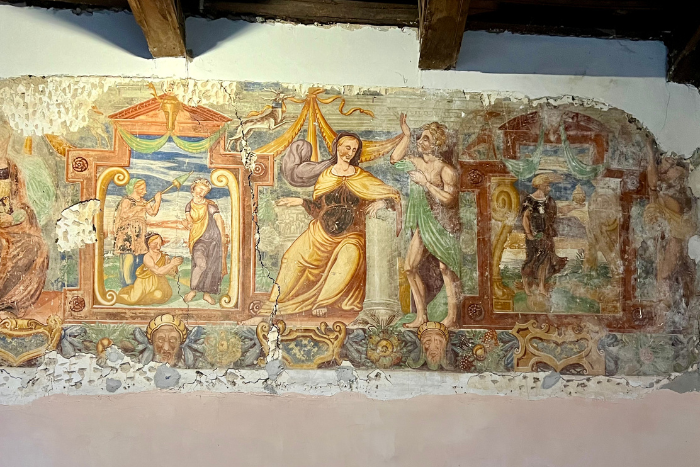
Restored and opened about a month ago, the new Sala delle Sorti enriches the visit to the Torre Alfina Castle, arousing great interest and curiosity among visitors. It is a room decorated with allegorical frescoes that probably date back to the 1660s and transport observers into a world of mystery and divination.
Table of contents:
  1. The House of Monaldeschi
  2. Allegorical frescoes
  3. Vices versus Virtues
  4. A historical-artistic testimony

The Prestige of the House

The decoration of the Hall of Fortunes was commissioned by Monaldo Monaldeschi della Cervara, canon of St. Peter's and an illustrious member of the Monaldeschi family that ruled the castle and the village of Torre Alfina for centuries. The hand behind the execution of these works remains shrouded in mystery, although a possible influence of the Venetian painter Bartolomeo Cinzio, whom Monaldo Monaldeschi knew well thanks to his stay in Padua, is speculated. The intention of the decoration was to artistically represent the prestige and moral propriety of the Monaldeschi family.

The Allegories of the Hall of Fortunes

The frescoes in the Sala delle Sorti are inspired by the book Il Giardino dei Pensieri by Francesco Marcolini da Forlì, published in 1540. This is a fortune-telling and fortune-telling text in which human vices and virtues are depicted. In the castle hall, depictions of the Vices, such as Insidiousness, Lies and Discord, alternate with those of the Virtues, such as Faith, Charity and Temperance. This juxtaposition reflects the eternal struggle between good and evil, the predictability and unpredictability of fate. But while the Virtues are portrayed indoors, symbolising their constant presence and fundamental role in maintaining morality and good governance, the Vices are depicted immersed in outdoor settings. The final visual effect is the feeling that imaginary windows open up in the room, allowing one to observe the evil that lives outside the castle walls.

Vices and Virtues

The frieze runs along the walls of the room and presents a repetitive pattern: each allegorical depiction of vices is followed by a telamon (a male figure supporting the architecture of the frieze) and then a virtue. Thus Insidiousness, a woman fishing in a river flanked by a lynx, is followed by Charity; Discord, a woman holding a bellows from which smoke comes out, is followed by Temperance. Each representation is rich in symbolic detail, offering a comprehensive overview of the forces that shape human destiny and inviting viewers to reflect on the choices and actions that define one's path.

Historical Testimony

The restoration and opening of the Sala delle Sorti in the Torre Alfina Castle is an extraordinary addition to the historical and artistic heritage of the region. This new space enchants and inspires visitors, offering them the opportunity to immerse themselves in a world of symbolism and mystery. The allegorical frescoes of the Sorti e le Virtù represent an important historical and artistic testimony to our region and the people who lived here. the room invites reflection on the forces that influence human destiny and the importance of moral choices. The richness of detail and profound significance of these works testify to the skill and vision of its creators, leaving an indelible imprint on the memory of those privileged enough to visit.

en_GBEnglish (UK)